
Top Ten Careers for the Future: 10 Jobs Freshers Can Start in 2026 Without Experience
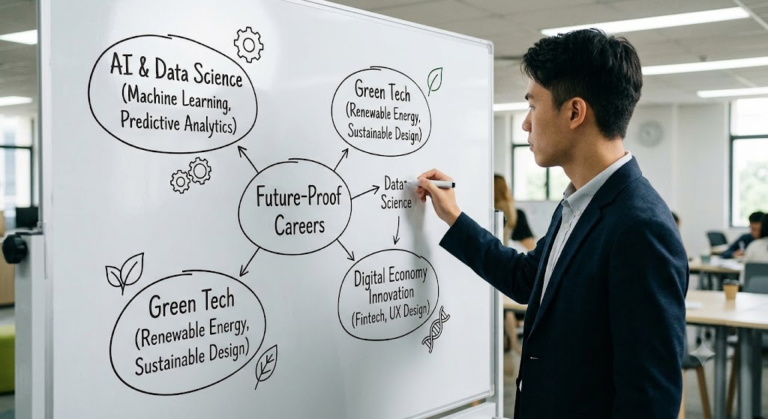
The top ten careers for the future that freshers can actually start in 2026 are digital marketing, data analysis, customer support, content writing, junior web development, graphic design, sales, recruitment, software testing, and virtual assistance. Every one of these hires people with no prior job experience, rewards skills you can learn free online in a few months, and is growing because businesses need more of it every year — not less.
That last point matters more than the job titles. A fresher’s biggest risk is not picking a “wrong” career; it is picking a career that is shrinking. If you spend two years learning a skill that employers are automating away, you graduate into a dead end. The ten careers below are the opposite: demand for them is rising, the entry door is open to beginners, and each one gives you a real skill you can carry to your next job.
This guide is written for someone starting from zero — no experience, no connections, maybe no degree in the field. For each career you will find what the job actually involves, why it has a future, and the fastest honest route in.
What makes a career “future-proof” for a fresher?
A future-proof career for a fresher needs three things at once, and most “best jobs” lists only check one of them.
First, demand must be growing, not just large. A job with a million openings today is no good if those openings halve in three years. Look for work tied to things businesses cannot stop doing: selling online, understanding customers, handling data, keeping software working.
Second, the entry door must be open to beginners. Some growing fields — medicine, law, senior engineering — need years of formal study before anyone will hire you. The careers in this list hire on demonstrated skill: a small portfolio, a certificate, or a test assignment, not a four-year degree in the subject.
Third, the skill must transfer. A good first career teaches you something that stays valuable even if you switch fields later. Learning to analyse data, write clearly, or sell honestly is useful in almost any job you take next.
If a career fails any one of these three tests, it did not make this list — no matter how popular it sounds on social media.
The top ten careers for the future freshers can start now
Here they are, one by one, with the honest route in for each.
1. Digital Marketing Executive Businesses now find customers online first, and someone has to run the ads, the social media, and the search results. A digital marketing executive plans and runs online campaigns, reads the numbers, and improves them. It will keep growing because every business that sells anything needs to be found online. The route in: Google’s free Digital Marketing & E-commerce certificate, plus one real project — run a small campaign for a local shop or a friend’s business, even unpaid, and show the before-and-after numbers. That one project beats a certificate alone in every interview.
2. Data Analyst (Junior) Companies collect more data than they can understand, and they pay people to turn it into decisions: which product sells, which customers leave, what to stock next. A junior data analyst cleans data in spreadsheets, builds simple dashboards, and answers questions with numbers. The route in: learn Excel properly, then SQL and one visualisation tool such as Power BI or Tableau — all free to learn. Build a portfolio of two or three small analyses using public datasets, and put the dashboards online. Employers hire junior analysts who can show a dashboard, not just claim a skill.
3. Customer Support Executive Every growing company needs people who can solve customers’ problems by chat, email, or phone — and this is one of the most reliable first jobs in the world. Support roles teach you product knowledge, patience under pressure, and clear written communication, which is why so many people move from support into sales, success, and operations roles. The route in: excellent written English, a calm tone, and typing speed. Many companies hire freshers directly and train them; a short stint answering real customer queries is the strongest proof you can offer in your next application.
4. Content Writer Every website, product, and brand needs words: blog posts, product descriptions, emails, help articles. A content writer who can explain things clearly and write for search engines is always in demand — and the demand grows as more businesses publish online. The route in: write five genuinely useful articles on a topic you know, publish them on a free blog or LinkedIn, and link them in your applications. Editors hire writers whose samples they can read, not writers whose resumes claim they can write.
5. Junior Web Developer Websites and web apps are not going away, and someone has to build and maintain them. A junior developer works on real products under a senior developer, fixing bugs and building small features. It is one of the highest-paying first jobs on this list, but it also demands the most preparation. The route in: HTML, CSS, JavaScript, and one framework — then three small projects live on the internet, with the code on GitHub. For a developer, the portfolio IS the resume; without one, applications are invisible.
6. Graphic Designer (Junior) Brands need visuals for everything — social posts, ads, presentations, packaging. Junior designers start with simple briefs: social media creatives, banners, basic layouts, and learn brand systems as they go. Design tools are free to learn now, and AI tools have made production faster, which means the designer’s judgment matters more, not less. The route in: Canva or Figma, ten polished pieces in a portfolio, and a willingness to redo work based on feedback. Clients and employers hire designers whose portfolio looks like the work they need.
7. Sales Executive / Business Development Every company lives or dies by sales, and sales is the career where your results speak loudest and your degree matters least. A business development executive finds potential customers, starts conversations, and closes deals — and good salespeople are promoted fast because their value is measurable in revenue. The route in: communication skills, resilience, and a willingness to make the first call. Many companies run paid training for freshers; the interview is often a role-play, so practise a short pitch before you go in.
8. Recruitment Associate Companies are always hiring, and recruitment agencies and in-house teams hire freshers to source candidates, screen resumes, and coordinate interviews. It is a people business: you learn how hiring actually works from the inside, which makes you a stronger candidate for every future job you apply for. The route in: a LinkedIn profile that looks professional, good written English, and the ability to talk to strangers politely. Recruitment firms routinely hire freshers with no experience and train them on the job.
9. Software Tester (QA) Before any app or website reaches users, someone has to break it on purpose — find the bugs, report them clearly, and check the fixes. QA testing is one of the most accessible doors into the tech industry: it needs careful thinking and clear communication more than coding, though learning basic automation later raises your pay fast. The route in: learn how testing works (free courses abound), practise by testing a real app and writing proper bug reports, and learn SQL basics. A tester who writes bug reports a developer can actually follow gets hired quickly.
10. Virtual Assistant / Operations Associate Remote work created a whole category of jobs: founders and small teams hire virtual assistants to handle scheduling, email, research, data entry, and coordination. Operations associates do similar work inside growing companies. The pay starts modest, but you learn how a real business runs from the inside — and many VAs specialise within a year into bookkeeping, social media management, or project coordination, where the pay jumps. The route in: reliability, fast replies, and one practical skill (spreadsheets, scheduling tools, or basic bookkeeping). A clean, error-free trial task is usually what wins the job.
How do I choose the right one from this list?
Do not pick by salary alone — pick by fit, because the first year is mostly learning, and you will only stick with something you do not hate.
Ask three questions. First: do I like working with people, numbers, or things I make? People-leaning freshers do best in support, sales, and recruitment. Number-leaning ones do best in data analysis and QA. Makers do best in writing, design, and development. Second: how much time can I spend learning before I earn? Development and data analysis need two to four months of serious study; support, recruitment, and sales can start within weeks. Third: what can I show in 30 days? Pick the career where you can build the strongest proof fastest — a portfolio, a project, a certificate — because proof is what gets a fresher hired.
Try before you commit. Spend one week on the free beginner course for your top two choices, and do one small real task in each. The one you actually enjoy doing at 10 pm after a long day is the right one. Passion is a weak predictor; willingness to practise is a strong one.
How can a fresher get hired with zero experience?
Experience is not the only currency — proof is. Employers hire freshers every day; they just do not hire freshers who offer nothing but a degree. Here is a 30-day plan that works for any career on this list.
Days 1–7: learn the basics. One free course, finished properly, with notes. Not three courses started — one completed. Days 8–21: build one real piece of proof. A small project, a portfolio piece, a campaign for a real business, a dashboard from real data — something with a result you can describe in one sentence. Days 22–30: apply in volume, with the proof attached. Ten targeted applications a day to jobs that genuinely fit, each with the proof linked, beats fifty generic applications with nothing attached.
One more truth: your first job will not be your dream job. It will be a job that teaches you something, pays you something, and puts a real line on your resume. That is enough. The top ten careers for the future reward the people who start, learn fast, and keep building proof — and the best time to start is before you feel ready.
Frequently Asked Questions
Which career is best for freshers in 2026?
There is no single best career — the best one is the one that fits how you like to work and that you can enter quickly with proof of skill. Digital marketing, data analysis, and customer support are the safest all-round picks: high demand, open to beginners, and skills that transfer to many other roles.
Can I get a job in these careers without a degree in the field?
Yes, for most of them. Employers in digital marketing, support, sales, content, design, and QA hire on demonstrated skill — a portfolio, a certificate, or a test task — not on the subject of your degree. A relevant degree helps, but it is rarely the deciding factor for an entry-level role.
How long does it take to become job-ready as a fresher?
Two to four months of focused learning for most careers on this list: about a month for support, sales, and recruitment; two to three months for marketing, content, and design; three to four months for data analysis, QA, and junior development. The timeline assumes daily practice and one finished portfolio project, not just watching courses.
Which of these future careers pays the most at entry level?
Junior web development and data analysis usually pay the most at entry level, followed by digital marketing. But pay at entry level is the wrong comparison — growth matters more. A salesperson or a support executive who moves into management can out-earn a developer within a few years, so choose by fit and by how fast the role lets you grow, not by the first salary alone.