
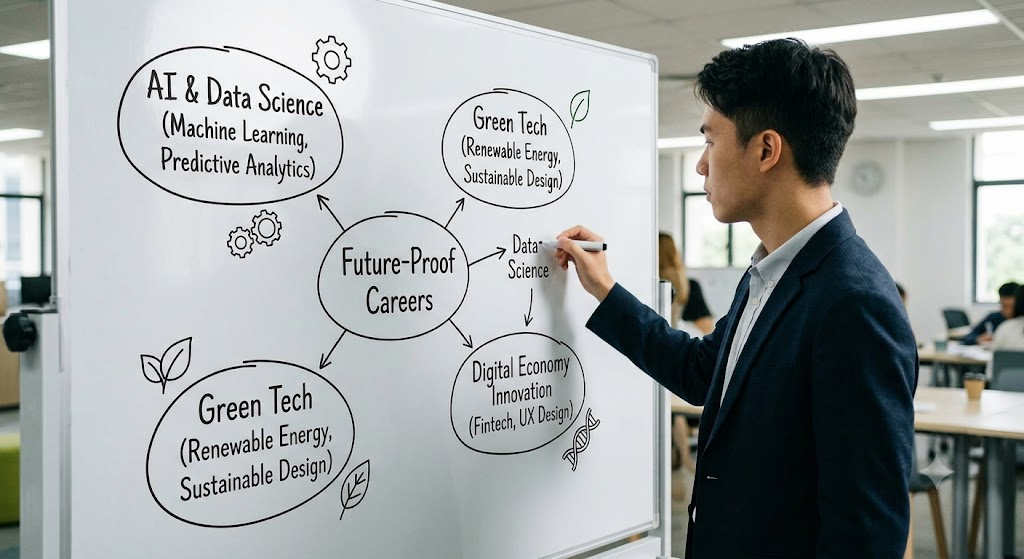
Best Careers for the Future: 10 High-Demand Jobs
What are the best careers for the future? The strongest bets combine growing demand, good pay, and resistance to automation: AI and data roles, cybersecurity, healthcare, software development, renewable energy, cloud computing, UX/UI design, digital marketing, and financial analysis. Below are ten high-demand careers worth considering, with the skills each one requires.
Artificial Intelligence (AI) Specialist
Artificial intelligence is transforming healthcare, finance, education, and manufacturing. AI specialists develop intelligent systems, automate processes, and improve business efficiency — and demand keeps climbing as adoption spreads.
Key skills: Python, machine learning, data analysis, problem-solving.
Cybersecurity Analyst
As cyber threats grow more sophisticated, organizations need experts to protect their data and systems. This career offers excellent job stability, competitive salaries, and a persistent talent shortage that favors job seekers.
Key skills: network security, ethical hacking, risk management, security tools.
Data Analyst and Data Scientist
Businesses rely on data to make decisions, and data professionals turn raw numbers into strategy. Data-related careers keep growing across nearly every industry, from retail to healthcare to sports.
Key skills: statistics, SQL, Python or R, data visualization.
Healthcare Professional
Healthcare remains one of the fastest-growing sectors worldwide. Doctors, nurses, pharmacists, therapists, and technicians are all in demand — and with aging populations, qualified professionals will be needed for decades. Healthcare is also one of the hardest fields to automate.
Key skills: clinical training, empathy, attention to detail, stamina.
Software Developer
Software developers create the websites, mobile apps, and programs millions of people use daily. Despite AI coding assistants, demand for developers who can design systems and solve novel problems stays strong — learning to code opens doors in almost every industry.
Key skills: programming languages, web and mobile development, software testing.
Renewable Energy Specialist
The global shift toward clean energy is creating jobs in solar, wind, and battery storage. As countries invest heavily in environmentally friendly energy, technicians, engineers, and project managers in this sector will see growing opportunity.
Key skills: electrical fundamentals, energy systems, project management.
Digital Marketing Specialist
Businesses increasingly live or die by digital channels. Digital marketing specialists combine creativity with analytical thinking — and the field offers strong remote-work opportunities and relatively low barriers to entry.
Key skills: SEO, content marketing, social media management, analytics, paid advertising.
Cloud Computing Engineer
Cloud technology lets businesses store and manage data efficiently, and engineers design, build, and maintain that infrastructure. As more companies migrate to cloud platforms, certified professionals remain highly sought after.
Key skills: cloud platforms (AWS, Azure, GCP), networking, DevOps basics.
UX/UI Designer
User experience and user interface designers make websites and apps intuitive and enjoyable. It is an attractive career for creative thinkers who like research and psychology — and good designers are hard to automate.
Key skills: design tools (Figma), user research, wireframing, visual design.
Financial Analyst
Financial analysts help businesses and individuals make informed investment decisions. As markets grow more complex globally, demand for financial expertise stays steady — and the analytical skills transfer well across industries.
Key skills: financial modeling, Excel, data analysis, business judgment.
How to Prepare for Future-Proof Careers
No matter which career you choose, continuous learning is the real future-proofing. Build technical skills through courses and projects, and pair them with durable human skills — communication, problem-solving, adaptability, and teamwork — that stay valuable whatever the technology. Start by matching these careers against your own strengths, then use our 7-step guide to choosing a career path to narrow the list to your best fit. For a closer look at this year’s market specifically, see the top high-demand careers in 2026.
Frequently Asked Questions
Which career has the most future demand?
Healthcare, AI and data, and cybersecurity consistently top demand forecasts because they combine structural growth with talent shortages. That said, the “best” future career is the one at the intersection of strong demand and your own strengths — demand alone will not sustain you through a decade of work you dislike.
Will AI replace these careers?
AI will change how these jobs are done, but roles built on judgment, creativity, human contact, and complex problem-solving are the hardest to automate — which is exactly why they made this list. The professionals at risk are the ones who refuse to learn the new tools, not the ones in these fields.
How do I switch into one of these high-demand careers?
Pick one target, learn its core skills through focused courses and portfolio projects, and reframe your existing experience around transferable value. Our 9-step guide to changing careers successfully walks you through the full transition.