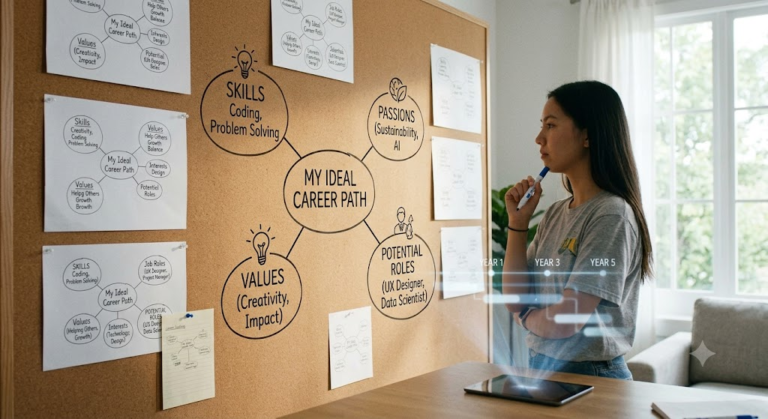

How to Discover Your Strengths: 8 Practical Exercises
How to discover your strengths? Combine self-reflection (interests, past wins), outside feedback (ask colleagues and friends), and structured assessments — then test your shortlist in real projects. Most people surface their core strengths within two to three weeks of deliberate exercises.
Why Knowing Your Strengths Changes Everything
Your strengths shape how you solve problems, communicate, and handle pressure. People who build careers around their strengths report higher satisfaction, learn faster, and get promoted sooner — while those who ignore them burn out in roles that fight their nature. Strengths are not just “things you are good at”; they are the abilities that energize you when you use them.
Exercise 1: Follow Your Energy
Start with what you love. List the activities that absorb you so completely you lose track of time, the topics you read about without being assigned, and the work that leaves you energized instead of drained. Energy is data — the tasks that charge you usually run on your natural strengths, while the ones that exhaust you rarely do.
Exercise 2: Mine Your Past Wins
Write down five to ten moments you are proud of — projects that succeeded, problems you solved, praise you received. For each one, ask: what exactly did I do that made it work? Which part came naturally? What did I enjoy most? Recurring patterns across your wins point straight at your strengths.
Exercise 3: Ask People Who Know You
Others often see our strengths before we do. Ask three to five people who have worked with or studied alongside you: “What do you think I do better than most people? When have you seen me at my best?” Collect the answers and look for overlap — the strengths everyone names are usually your real ones.
Exercise 4: Inventory Your Skills
Make two lists. First, your technical skills: programming, writing, design, data analysis, languages, tools you have mastered. Second, your soft skills: communication, leadership, teamwork, creativity, problem-solving, staying calm under pressure. Rate each one honestly from 1 to 5 — your 4s and 5s are your current strength inventory.
Exercise 5: Try New Things Deliberately
Hidden strengths only surface under new demands. Volunteer for an unfamiliar task, join a club, take a weekend workshop, or start a small side project. Pay attention to what feels surprisingly easy — ease is the fingerprint of a strength you have not named yet.
Exercise 6: Take a Structured Assessment
Career and personality assessments give you vocabulary for what you feel intuitively. Try one of the best career assessment tools to get a structured profile of your aptitudes and work style — then combine the results with your own reflection and feedback for the most accurate picture. No test is destiny, but good ones are excellent mirrors.
Exercise 7: Watch for Patterns
Lay your lists, wins, feedback, and assessment results side by side. Circle the themes that repeat in three or more sources — those are your confirmed strengths. Write them as short statements: “I explain complex ideas clearly,” “I stay organized under chaos,” “I learn new tools fast.” Specific beats generic every time.
Exercise 8: Test and Confirm in Real Work
A strength is only real if it performs under pressure. Volunteer for a project that demands your suspected strength and watch the results: do you deliver faster, enjoy it more, and get better feedback than others? Confirmation in real work turns a hypothesis into a strength you can confidently claim on resumes and in interviews.
How to Use Your Strengths Once You Find Them
Discovery is step one; deployment is the payoff. Steer your career path toward roles that use your top strengths daily, shape your career goals around amplifying them, and lead with them in interviews — “here is what I do best, and here is the proof.” Keep developing them deliberately; even natural strengths compound with practice.
Frequently Asked Questions
What if I cannot identify any strengths?
Everyone has strengths — the issue is usually recognition, not absence. Start with Exercise 3 (ask others) and Exercise 2 (past wins); outside perspectives and concrete evidence break through self-doubt faster than introspection alone. A structured assessment also helps when you feel stuck.
What is the difference between strengths and skills?
Skills are learned abilities (Excel, public speaking, coding); strengths are the natural talents and patterns that make learning and using certain skills easier and more energizing. Skills can be trained — strengths tell you which skills are worth training.
Should I focus on strengths or fix weaknesses?
Invest most of your energy in strengths — that is where your greatest returns live. Fix only the weaknesses that actively block your goals (a “fatal flaw” like chronic lateness), and otherwise manage around the rest by partnering with people whose strengths complement yours.